
What Size Pool Heat Pump Do I Need?
Choosing the right pool heat pump is about more than pool litres. Your location, swimming season, target water temperature, pool cover and heat loss all affect the heating capacity your pool needs.
How Do You Size a Pool Heat Pump?
Start with your pool volume, then adjust for your climate, target temperature, swimming season, pool cover and exposure.
As a general Australian starting point, many residential pools use heat pumps between approximately 11.5kW and 32kW+. A smaller covered pool used in summer may require far less capacity than a similarly sized uncovered pool expected to stay warm through a Victorian spring or autumn.
This is why Avenza Pro recommends sizing for how you actually want to use the pool rather than choosing from litres alone.
Pool Heat Pump Size by Pool Volume
Use this table as an initial guide only. Final sizing should account for location, cover use, target temperature and swimming season.
| Pool Volume | Indicative Heat Pump Class | Typical Application | Important Considerations |
|---|---|---|---|
| Up to 25,000L | 11.5–12.5kW | Plunge pools, compact pools and smaller residential pools | Cover use and desired heat-up speed remain important. |
| 25,000–40,000L | 12.5–19kW | Small to medium family pools | Cooler climates or extended-season swimming may favour the upper end. |
| 40,000–55,000L | 16.5–22kW | Typical family swimming pools | Climate and pool cover can make a significant difference to final selection. |
| 55,000–70,000L | 19–26kW | Medium to large residential pools | Consider higher capacity for cooler regions and faster recovery. |
| 70,000–90,000L | 22–32kW | Large family pools and higher heating-demand applications | Extended and year-round operation requires careful site-specific sizing. |
| 90,000L+ | 26–32kW+ | Very large residential, indoor and specialist pool applications | Professional heat-load assessment is recommended. |
What Size Heat Pump for My Pool?
These are useful starting ranges for common Australian residential pool volumes.
Consider larger capacity for cool climates or longer swimming seasons.
A common class for medium residential pools.
Climate, cover use and desired season become particularly important.
Higher capacity can improve recovery in cooler conditions.
Professional sizing is recommended, especially for year-round heating.
Calculate Your Pool Volume
Pool volume is the starting point for sizing. For a rectangular pool, multiply the length by the width and average depth, then multiply by 1,000.
For irregular or freeform pools, use the manufacturer's stated pool volume where available or calculate an approximate average volume.
= approximately 48,000 litres
Adjust for Your Australian Climate
Two identical pools can require very different heating capacity depending on where they are located.
Queensland & Northern NSW
Locations such as Brisbane, the Gold Coast, Sunshine Coast and northern NSW generally have warmer ambient conditions and a lower heating demand than southern Australia.
Summer and extended-season heating can often be achieved with less capacity than in a cold-climate installation.Sydney, Adelaide & Perth
Moderate climates still experience cooler nights and shoulder-season heat loss, so sizing should be matched to how early and late in the season you want to swim.
Extended-season goals usually justify more capacity than summer-only heating.Victoria & Canberra
Melbourne, Geelong, Ballarat, regional Victoria and Canberra experience cooler nights and stronger seasonal heating demand.
Pools in cooler climates often benefit from selecting toward the higher end of the appropriate capacity range.How Long Do You Want to Swim?
Your intended swimming season is one of the most important factors when choosing a pool heat pump.
Summer Support
Suitable when you mainly want to take the chill off the pool during warmer months or recover temperature after cooler weather.
Extended Season
For swimming through spring, summer and autumn, sizing needs to account for lower ambient temperatures and greater overnight heat loss.
Year-Round Heating
Maintaining swimming temperatures through winter can create significantly higher heating demand, particularly in southern Australia.

Consider Your Target Water Temperature
Heating a pool to 26°C is a different task to maintaining it closer to 30°C, particularly when outdoor temperatures fall.
The larger the difference between the pool temperature you want and the surrounding conditions, the more heat the system needs to replace.
- Higher target temperatures increase heating demand
- Cooler nights increase heat loss
- Wind can increase evaporative heat loss
- Initial heat-up requires more output than maintaining temperature
- A covered pool retains temperature more effectively
Does a Pool Cover Affect Heat Pump Sizing?
Yes. Whether the pool is covered can make a major difference to heat retention and day-to-day heating demand.
Pool With a Cover
- Better overnight heat retention
- Reduced evaporation
- Easier temperature maintenance
- Reduced reheating demand
- Better performance through cooler weather
Uncovered Pool
- Greater evaporative heat loss
- Greater sensitivity to wind
- More overnight temperature loss
- Longer recovery time
- May require greater heating capacity
Is a Bigger Pool Heat Pump Better?
Not automatically — but there are advantages to having sufficient capacity.
A higher-capacity inverter heat pump can provide stronger initial heat-up and better recovery during cooler conditions. Once the pool approaches its target temperature, an inverter system can reduce its operating output to maintain temperature.
The goal is therefore not simply to buy the biggest heater available. It is to choose enough capacity for your pool's real heating load.
- Faster initial heat-up potential
- Better cold-weather capability
- Greater capacity for extended-season heating
- More flexibility for higher target temperatures
Choose the Right Orilux Range
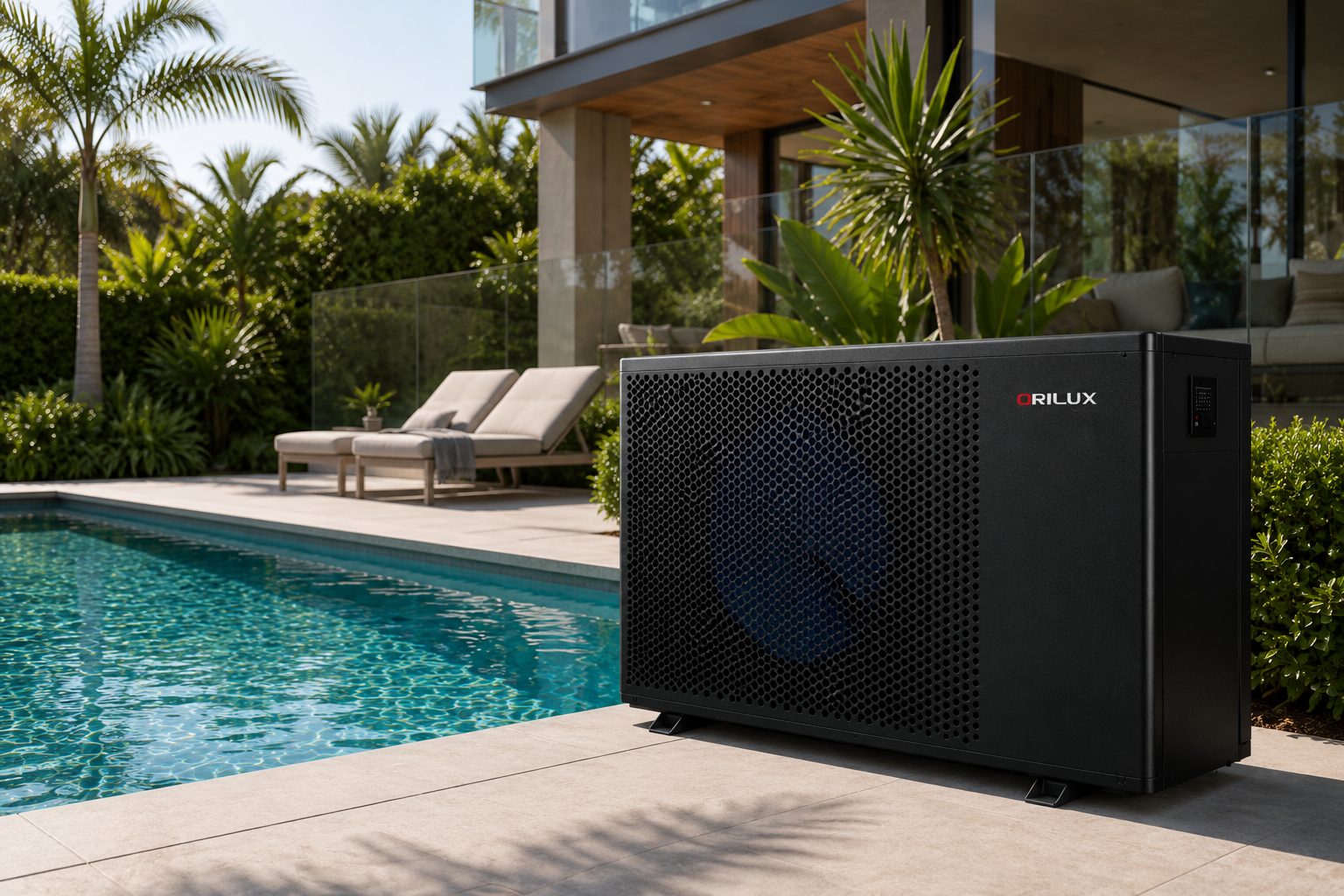
Avenza Pro offers multiple Orilux R290 heat pump platforms covering small residential pools through to larger and higher-demand applications.
Orilux OX16
12.5kW, 16.5kW and 19.5kW models for residential pool heating across a range of Australian conditions.
Explore OX16
Orilux OX20
Higher-capacity R290 inverter pool heating suited to larger pools, longer swimming seasons and stronger heating requirements.
Explore OX20
Orilux OX26
Premium high-efficiency R290 inverter heating with multiple capacities for residential pools and demanding climates.
Explore OX26Common Pool Heat Pump Sizing Mistakes
Correct sizing is about designing for the result you want — not simply matching a heater to a number of litres.
Sizing by Litres Alone
Pool volume is only the starting point. Climate and heat loss can change the result.
Sizing for Summer
A heater selected for January conditions may disappoint if you expect to swim in September.
Ignoring the Pool Cover
An uncovered pool can lose substantially more heat and require greater daily recovery.
Comparing kW Only
Also consider efficiency, ambient performance, inverter operation, installation and support.
Calculate the Right Heat Pump for Your Pool
Enter your pool details, location and heating requirements into the Avenza Pro heat pump calculator, or speak with an authorised dealer for a site-specific recommendation.
Frequently Asked Pool Heat Pump Sizing Questions
Quick answers to common questions Australian pool owners ask when choosing a heat pump.
What size pool heat pump do I need?
The correct heat pump size depends on pool volume, location, target temperature, swimming season, pool cover use, wind exposure and heat loss. Pool litres are a starting point rather than the only factor.
What size heat pump do I need for a 30,000 litre pool?
A heat pump in approximately the 12.5kW to 17kW class may be a useful starting point for a 30,000 litre residential pool. Cooler climates, longer swim seasons or uncovered pools may require greater capacity.
What size heat pump do I need for a 40,000 litre pool?
A 40,000 litre pool commonly falls around the 16.5kW to 19kW class as an initial starting point. Final sizing depends on location, temperature goals, pool cover and swimming season.
What size heat pump do I need for a 50,000 litre pool?
Around 19kW to 22kW can be a useful starting range for a 50,000 litre pool. Cooler regions such as Melbourne, Geelong, Ballarat or Canberra may justify greater heating capacity depending on the desired season and pool cover use.
What size heat pump do I need for a 60,000 litre pool?
A 60,000 litre pool often starts around the 22kW to 26kW heat pump class. The final choice should take into account climate, cover use, target water temperature and desired heat-up speed.
What size heat pump do I need for an 80,000 litre pool?
An 80,000 litre pool may require approximately 26kW to 32kW or more depending on the climate, exposure and intended swimming season. Professional sizing is recommended for higher-demand installations.
Does my location affect pool heat pump sizing?
Yes. Ambient temperature and overnight heat loss vary significantly across Australia. The same pool will generally have a greater heating demand in Melbourne or Canberra than in Brisbane or the Gold Coast.
Does a pool cover reduce the heat pump size I need?
A pool cover reduces heat loss and helps retain temperature overnight. This can reduce the heating demand placed on the heat pump and improve overall heating performance.
Is it better to oversize a pool heat pump?
Some additional capacity can improve heat-up and cold-weather performance, particularly with an inverter heat pump. However, the system should still be selected for the pool's actual heating requirements rather than simply choosing the largest available model.
How long does a pool heat pump take to heat a pool?
Heat-up time depends on pool volume, starting water temperature, target temperature, heat pump capacity, ambient weather, wind exposure and whether the pool is covered. Initial heating typically takes considerably longer than maintaining a pool that is already warm.
Should I size my heat pump for summer or winter?
Size the system around the period when you genuinely want to use the pool. If you want extended-season or year-round swimming, the heat pump needs to be selected for cooler conditions rather than peak summer weather.